
Emotional Eating: Why It Happens & How to Break the Cycle for Good
We need to talk about something that almost nobody in the weight loss world is honest about.
There are times when you're eating, but not because you're hungry. You know that. And yet, there you are at 9 pm, standing in front of the open fridge, having just finished dinner an hour ago. Or you've had a rough day at work, and the bag of chips is suddenly empty before you even realize you started eating.
That's emotional eating. And if it sounds familiar, you are definitely not alone, and you are absolutely not broken.
Here's what I want you to know before we go any further: emotional eating doesn't make you weak. It doesn't mean you have no willpower. It means you're a human being who learned to use food to cope with feelings, and that coping mechanism makes complete biological sense.
Understanding why it happens is actually the first step toward changing it, so let's start there.
What Is Emotional Eating?

The emotional-eating meaning that most diet culture gives you is overly simplistic: "you eat when you're not hungry." But it's so much more layered than that.
Emotional eating means using food to manage, suppress, or respond to emotions rather than to satisfy physical hunger. It's not about lack of discipline. It's about the fact that food is one of the most powerful and immediate sources of comfort.
It is comfort that is readily available, fast, and socially acceptable. Nobody judges or questions you for grabbing a snack… Especially when no one else knows about it!
The problem isn't that food makes you feel better in the moment, but that it doesn't actually deal with the underlying emotion; it just temporarily numbs it. And then the emotion comes back, often with a side of guilt and frustration, which can kick off another round of emotional eating. That can be a tough cycle to break
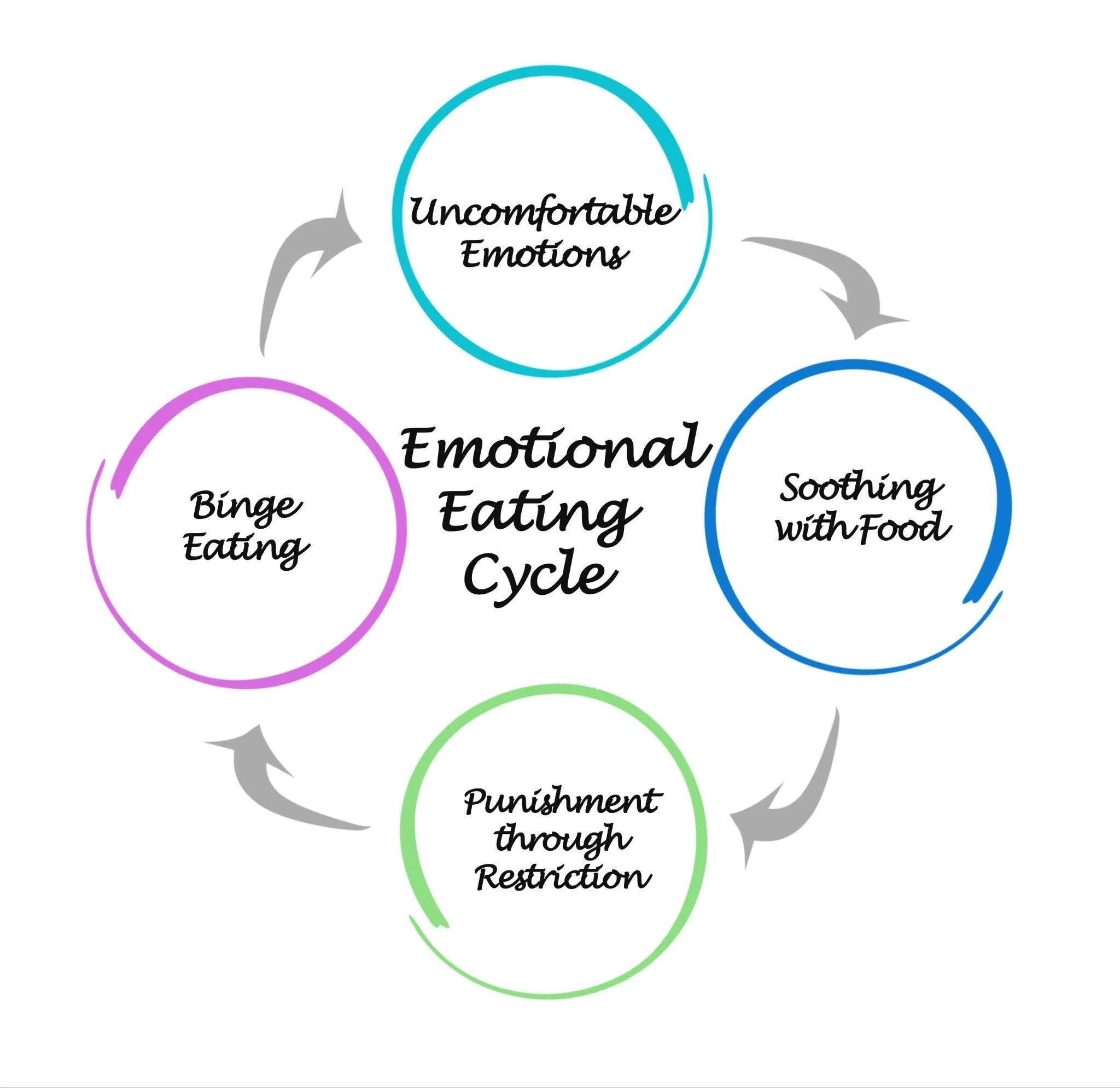
Common emotional eating triggers include:
Stress: Work pressure, financial worries, or relationship tension raises cortisol levels, which can actually increase your appetite and cravings for high-fat, high-sugar foods.
Boredom: Eating as a way to fill time or add stimulation when you have some downtime.
Loneliness or social disconnection: Food as a form of comfort or company.
Anxiety: The act of eating can sometimes feel soothing and grounding when your mind is racing.
Exhaustion: When you're overtired or running on empty, your brain reaches for quick energy (usually sugar), and your ability to make intentional decisions drops significantly.
Celebrations and social situations: Emotional eating isn't always about negative emotions; overeating at parties, rewarding yourself with food, eating because of pressure from others, or eating out of social obligation counts too.
If you've been reading this and nodding along, keep going. Recognizing emotional eating triggers in your own life is a powerful starting point.

Why Recognizing Emotional Eating Triggers Is So Important
Here's something I've seen over and over again with my clients: the women who make the most lasting progress aren't always the ones who had the "perfect" nutrition plan. They're the ones who got really honest with themselves about when and why they were eating.
Recognizing emotional eating triggers isn't about beating yourself up. It's about getting curious instead of judgmental. When you notice yourself reaching for food outside of genuine hunger, the question to ask isn't "What's wrong with me?" - it's "What's going on with me right now?"
A simple way to start is to pause before eating and run a quick internal check:
👉 On a scale of 1–10, how physically hungry am I? Am I hungry enough to eat some broccoli (or any other nutritious food?
If the answer is below a 5 or 6, something else is probably driving the urge. That's not a reason to feel guilty; it's information.
You can also start keeping a simple food-and-mood journal. Not to track every calorie, but just to notice patterns.
❓ Does stress at work tend to lead to afternoon snacking?
❓ Do you tend to overeat when you're watching TV at night?
❓ Does socializing leave you feeling like you "deserve" to indulge more than usual?
Patterns become visible over time, and visibility gives you choices.
If you're ready to understand your emotional eating and change the cycle, I can help you identify your triggers and build healthier ways to cope.
The Science Behind Why Food Feels So Good When You're Emotional
I want to spend a minute here because understanding this actually makes emotional eating feel a lot less like a personal failing.
Why Sugar, Fat, and Salt Feel So Rewarding
When you eat foods that are high in sugar, fat, or salt (the exact foods most people reach for when they're stressed or sad), your brain releases dopamine. Your brain essentially learns how to achieve short-term reward fast: feeling bad > eat this > feel better. Over time, that pathway gets reinforced and automatic.
How Stress and Cortisol Increase Food Cravings
On top of that, stress hormones like cortisol increase your cravings for calorie-dense comfort foods specifically. Your body is biologically wired to seek quick energy when it perceives stress.
Why Willpower Alone Isn't Enough
The neurological pathways driving this behavior are real. Trying to override them with sheer willpower alone is like trying to swim upstream. What you can do, instead, is come up with strategies that work with your brain, not against it.

How to Break the Emotional Eating Cycle: Strategies That Actually Work
Okay, so you understand what emotional eating is and why it happens. Now let's talk about what to actually do about it. These are the emotional eating strategies I come back to with my clients again and again because they work in real life.
1. Create a Gap Between the Trigger and the Response
One of the most effective things you can do is simply build a pause. When you notice the urge to eat, and you're not physically hungry, give yourself 10 minutes before acting on it.
⏲️ Set a timer if you have to. Most emotional eating urges peak and then pass. That gap gives your rational brain a chance to catch up with your emotional brain.
During those 10 minutes, name the emotion. Say it out loud or write it down. "I'm anxious about the meeting tomorrow." "I'm bored." "I feel overwhelmed."
Then, go do something else for the remaining 10 minutes. Don’t just stare at the timer as it counts down. It could be something productive or something fun, but do something!
This sounds almost too simple, but naming an emotion and then distracting yourself actually takes some of its power away. It moves you from reacting to responding.
2. Build a Go-To List of Alternatives for Emotional Eating
This is something I recommend every single one of my clients do: create a list of alternatives for emotional eating before you need them. Not generic advice like "go for a walk" but a real, personalized list of things that actually work for you.
✍️ Your list might include:
Calling a friend
Going outside for five minutes
Doing a quick workout
Journaling
Taking a bath
Putting on a specific playlist
Doing a five-minute breathing exercise
Watching something that makes you laugh
Whatever works for you. Create this list when you're calm and clear-headed, not in the middle of a stress spiral when your brain is already defaulting to autopilot.
Having go-to alternatives for emotional eating doesn't mean you're never allowed to enjoy food emotionally. Eating birthday cake because it's your birthday and you're happy is part of life. The goal isn't to make food emotionally neutral.
3. Don't Let Hunger Make the Problem Worse
One of the biggest drivers of emotional overeating that doesn't get talked about enough: under-eating during the day.
🍛 When you're running low on fuel by 5 pm, especially when you skipped breakfast, had a sad desk lunch, or just didn't eat enough, you are biologically primed for overconsumption. Your blood sugar is unstable, your willpower is depleted, and your emotional state is amplified.
Making sure you're eating enough, eating regular meals, and including satisfying protein and fiber throughout the day genuinely reduces the intensity of emotional eating episodes. It doesn't eliminate them, but it removes the physiological accelerant.
Explore over 10 healthy meal ideas cooked under 20 minutes!
4. Practice Self-Compassion, Not Self-Criticism
I know this sounds soft. Stay with me for a hot second.
Research consistently shows that self-criticism after overeating actually increases the likelihood of further overeating.
Shame and guilt activate stress responses, which bring us right back to the beginning of the emotional eating cycle. So every time you beat yourself up after an emotional eating episode, you are literally making the problem harder to solve.
Self-compassion isn't about letting yourself off the hook. It's about treating yourself the way you'd treat a good friend. You wouldn't tell your best friend she's pathetic for stress-eating after a terrible week. You'd be understanding.
Apply the same kindness toward yourself.

5. Address the Underlying Stress
This is the piece that a lot of diet programs skip entirely, and it's honestly the most important one for long-term change.
If your life is chronically stressful, busy, and overwhelming, addressing the eating without addressing the stress is like bailing out a boat without plugging the leak.
This doesn't mean you need to overhaul your entire life overnight. But it does mean building in genuine recovery:
✔️ Regular sleep
✔️ Some form of movement
✔️ Enjoy downtime that's actually yours
✔️ Support from people who understand what you're going through
The long-term work of overcoming emotional eating happens in the life around the food, not just in the food choices themselves.
What Overcoming Emotional Eating Actually Looks Like
Overcoming emotional eating doesn't mean you'll never eat for any reason other than hunger again. It means you develop awareness of what you're doing and why.
Progress tends to look less like "I stopped emotional eating completely" and more like:
"I caught myself reaching for food and paused to figure out what I actually needed."
"I still had the snack, but I did it consciously and without guilt instead of on autopilot."
"I noticed I was stress-eating more this week and realized I hadn't been sleeping well. So I worked on the sleep."
Small shifts in awareness and behavior, repeated over time, are what create lasting change. That's the whole philosophy behind the way I work with clients; no extreme plans, no restriction, no shame spirals. Just sustainable habits that actually fit your life.
When to Get Support for Emotional Eating
If you recognize yourself in this cycle, you don't have to keep figuring it out on your own. I work with women who want to understand their emotional eating, identify what's really driving it, and build a healthier relationship with food.
The Bottom Line
Emotional eating is real, it's common, and it makes complete sense given how our brains work. It's not a character flaw. It’s a coping mechanism that can be unlearned.
The path forward isn't restriction, willpower, or guilt. It's awareness, self-compassion, practical strategies, and addressing the underlying emotions and stress that are driving the behavior in the first place. That's the kind of sustainable, non-restrictive approach to weight loss that I practice and that works long-term.
You've got this. And if you need help, I'm here. Get in touch with me and let’s talk.
Frequently Asked Questions About Emotional Eating
-
Emotional eating means using food to manage or respond to emotions rather than physical hunger. Normal eating is driven by your body's need for fuel: you feel hungry, you eat, and the hunger goes away.
Emotional hunger tends to come on suddenly, craves specific comfort foods, and is often followed by guilt. Physical hunger builds gradually and feels satisfied by most foods.
-
A few honest questions to ask yourself:
Do you often eat when you're not physically hungry?
Do you find yourself eating more when you're stressed, tired, or overwhelmed?
Do you use food as a reward or a way to cope with difficult emotions?
Do you feel guilty or ashamed after eating, even when you weren't especially hungry to begin with?
If you said yes to more than one of these, emotional eating is likely playing a role in your relationship with food, and that's more common than you think.
-
The goal isn't to avoid emotional eating entirely, but to reduce how automatic and unconscious it is, and to build other coping tools alongside food.
Food is a source of pleasure and comfort, and that's not inherently bad. The problem is when it is your only tool for managing hard emotions. Most people who work through this don't stop enjoying food emotionally. Instead, they just develop more awareness and more options, so food is a choice rather than a default.
-
The most effective alternatives are the ones that work for you specifically, which is why I always recommend building your own personalized list ahead of time.
That said, common ones that tend to help: a short walk or any movement (even five minutes), calling or texting a friend, journaling for a few minutes, a breathing exercise, making a hot drink and sitting with it, or doing something with your hands (a puzzle, a craft, tidying a small space).
-
Evening is prime time for emotional eating for a few reasons. First, you're likely physically, mentally, and emotionally depleted after a full day, which reduces your ability to make intentional decisions.
Second, if you've been restricting or under-eating during the day, your blood sugar and energy are low, making cravings much harder to resist. Third, nighttime tends to be when the busyness stops and emotions surface.
The fix is a combination of eating enough during the day, building an evening routine that provides comfort in other ways, and addressing the stress or exhaustion that's driving the urge in the first place.
