

You've probably been told to "just eat less and exercise more." If you have polyendocrine metabolic ovarian syndrome, (formerly called Polycystic Ovarian syndrom or PCOS,) you already know it's not that simple.
1 in 8 women live with the hormonal imbalances that drive PMOS (previously known as Polycystic Ovary Syndrome (PCOS)), and no amount of calorie counting fixes that. A PMOS diet works differently. It's about stabilizing blood sugar, calming inflammation, and eating in a way that supports what your body needs most. When you eat with your body instead of against it, everything changes. That's what working with a specialist PMOS nutrition coach makes possible.
No restrictive meal plans. No cutting out entire food groups. Just a real strategy built around your body and your life.

You're Doing Everything "Right" and the Scale Still Won't Budge...
You're Doing Everything "Right" and the Scale Still Won't Budge...

If you've been eating well, moving your body, and still watching the number on the scale refuse to shift, first, take a breath. And then hear this: it is not your fault. PMOS weight loss is genuinely, physiologically harder. That's not an excuse or a comfort prize. It's biology.
The frustration is real. You're skipping dessert, meal prepping on Sundays, dragging yourself to workouts even on the days you feel exhausted, yet still not seeing progress. Meanwhile, the cravings feel relentless, your energy crashes by 2 p.m., and every piece of advice you've tried has eventually let you down.
There's also the emotional weight of it. Feeling like your body is working against you, like you're somehow doing it wrong when you're clearly trying so hard; that kind of discouragement runs deep. And it's something I see with almost every woman who comes to me after years of spinning her wheels.
The good news is, there is a way forward. It just looks different than what you've probably been told.
PMOS Isn't Just a Hormone Problem. It's a Whole-Body Problem, And That Changes Everything.
Once you understand that, it becomes easier to see why the standard ‘eat less, move more’ approach can feel ineffective for many people with PMOS.
Insulin Resistance
When your cells don't respond to insulin the way they're supposed to, your body compensates by producing more of it. Higher insulin levels make fat storage easier and fat loss harder, not because you're lazy or undisciplined, but because that's what elevated insulin does. It's a metabolic reality, not a character flaw.
Inflammation
Chronic low-grade inflammation is also part of the picture. That's part of why aggressive calorie restriction and high-intensity cardio can actually make things worse for some women. The added physical stress fuels more inflammation, which makes the hormonal chaos louder, not quieter.
Many women with PMOS are also managing overlapping conditions like hypothyroidism, anxiety, or irregular cycles, all of which add layers of complexity that a generic diet plan simply isn't equipped to handle.

A PMOS Diet Isn't About Restriction. It's About Working Smarter.
Let's get one thing out of the way: you do not have to go keto, cut carbs forever, or survive on a list of "approved" foods to manage PMOS. That narrative has caused a lot of unnecessary suffering, and it's simply not backed up by what actually works long-term.
What does work? A personalized nutrition approach built around blood sugar balance, adequate protein, anti-inflammatory eating habits, and — crucially — sustainability. Because a plan you can't maintain for more than three weeks isn't a strategy. It's just another diet.
I've worked with women who were completely convinced they could never lose weight with PMOS. They did, and not by giving up everything they loved, but by making consistent, realistic changes that fit into their actual lives. That's the kind of progress that lasts.Here's what a smarter approach to PMOS nutrition actually looks like:
🍫 Blood sugar-balancing meal strategies — without eliminating carbs entirely
🧆 Protein targets that support satiety, muscle, and hormonal health
🍚 Anti-inflammatory eating habits built around real food you genuinely enjoy
🧘 Mindset and behavior coaching woven into the process — because PMOS affects how you feel, not just what you eat
💪 Flexibility for real life — dining out, busy weeks, social events, all of it
A good PMOS nutrition coach doesn't hand you a rigid protocol and wish you luck. She helps you figure out what actually works for your body, your schedule, and your preferences — and then builds from there.
This Is for You If…
PMOS nutrition coaching isn't for everyone, but if any of the following sounds familiar, you're probably in the right place. You might be a great fit if:
✔️ You've been diagnosed with PMOS, or suspect you might have it, and feel stuck when it comes to your weight and energy
✔️ You've tried low-carb, keto, or calorie restriction and haven't seen lasting results
✔️ You're exhausted by conflicting information online about what you're "supposed" to eat with polyendocrine metabolic ovaries
✔️ You want a sustainable plan, not another diet, that you can actually maintain
✔️ You're open to working on habits and mindset alongside nutrition, not just following a meal plan

Here's What We'll Actually Do Together
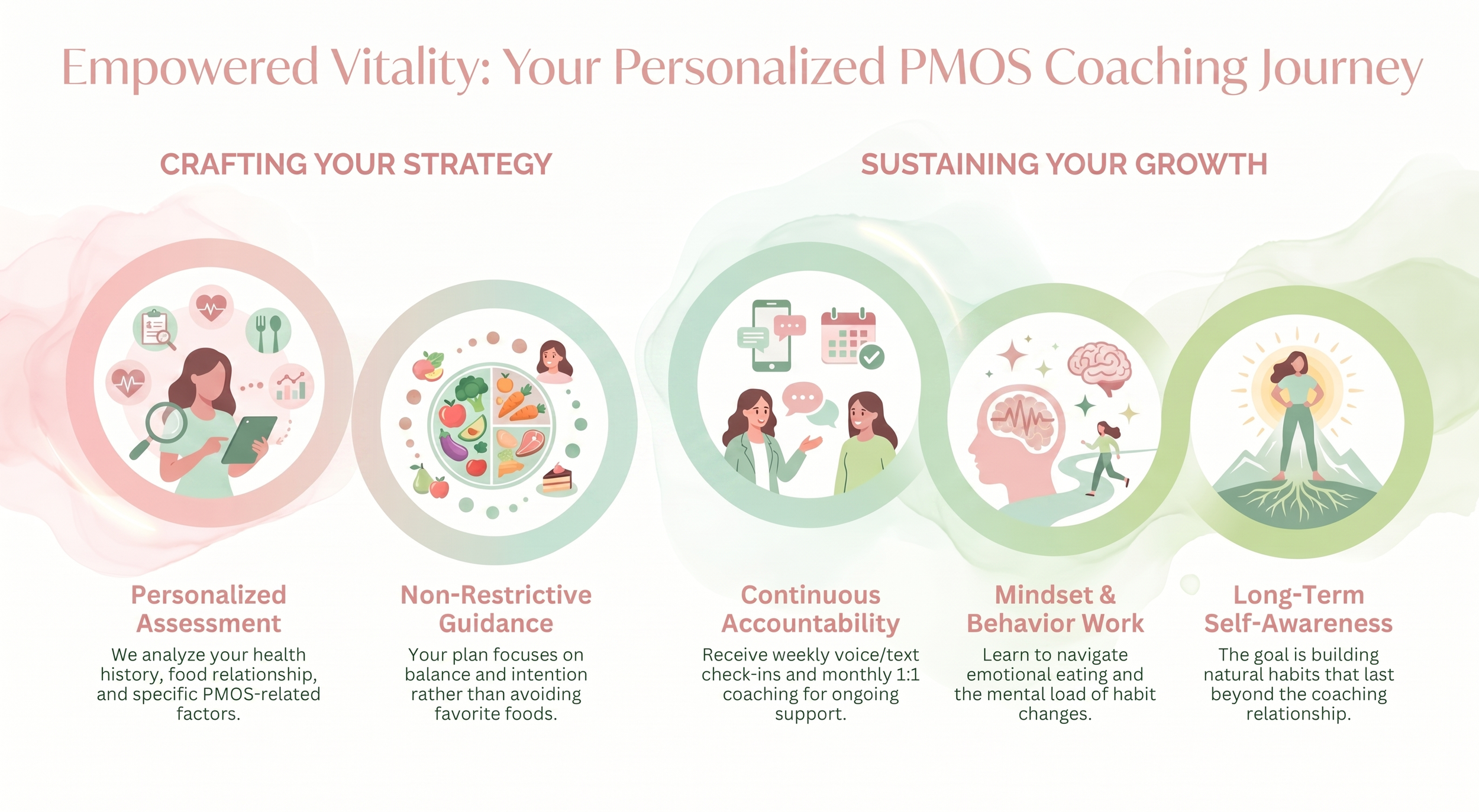
This isn't a program where you fill out a form, get a PDF, and never hear from anyone again. Coaching with me is a real, ongoing relationship built around your life, your history, and your goals.
Here's how it works in practice:
Personalized assessment. I start by understanding your health history, your relationship with food, your schedule, your goals, and what's gotten in the way before.
A nutrition strategy that fits your life. You will receive a real plan designed around the foods you like, the time you actually have, and the PMOS-specific factors affecting your body.
Ongoing support & accountability. You’re not alone in this journey. We will have regular check-ins to keep you on track or ensure the path you’re on is benefiting you. You’ll get weekly voice or text check-ins for support and clarity, and monthly 30-minute 1:1 coaching sessions (for Gold or Platinum programs).
Mindset and behavior work. Because eating well isn't just about knowing what to eat, but about navigating emotional eating, motivation dips, and the mental load of changing habits under real-life pressure.
Flexible and non-restrictive nutrition guidance. Instead of avoiding your favorite foods, the PMOS diet you will follow will focus on balance and intention. Your plan will consist of realistic food plans that match your energy levels and weight goals.
The goal isn't to keep you dependent on a coach forever. It's to help you build the self-awareness and habits that make healthy choices feel natural, even in hard weeks.

The goal isn't to keep you dependent on a coach forever. It's to help you build the self-awareness and habits that make healthy choices feel natural, even in hard weeks.
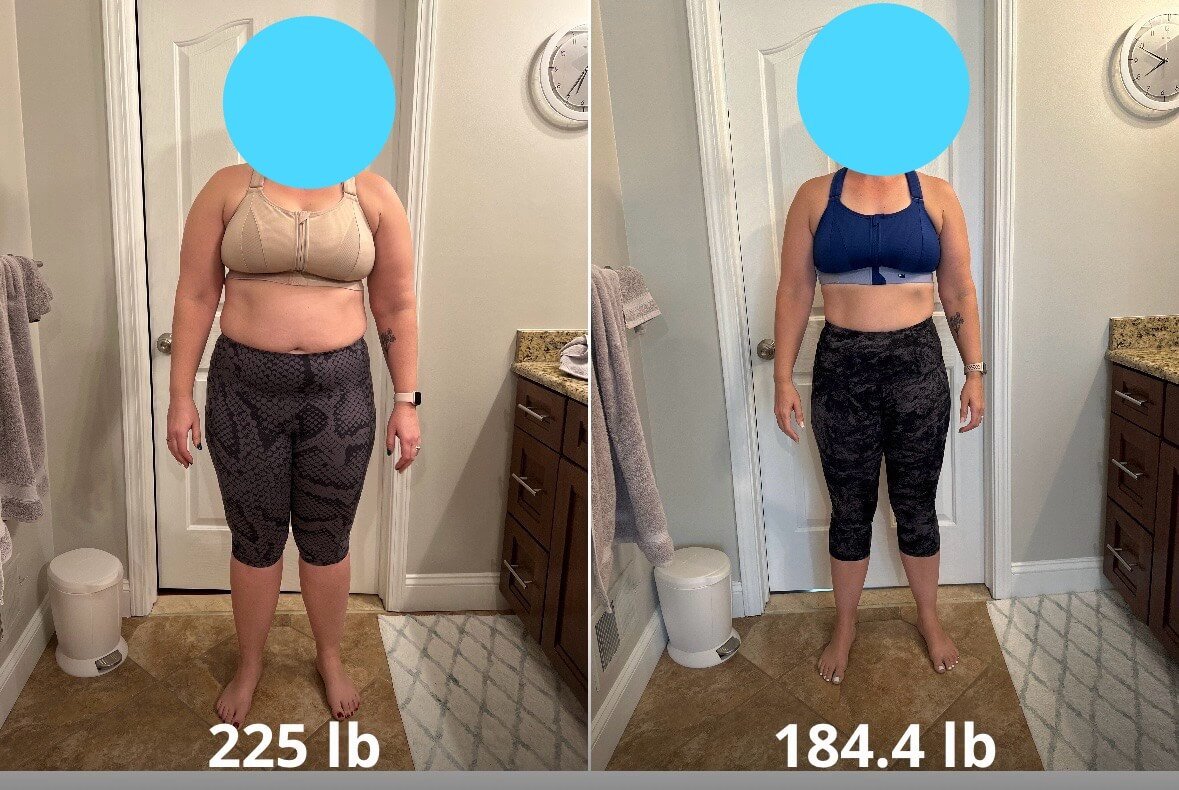
★★★★★
“Working with Sarah has been life-changing and I am so glad I took the step to work with her.
Sarah worked to hold me accountable for my actions and taught me strategies for holding myself accountable so I can continue to be successful without her. ”

You Don't Have to Keep Fighting Your Own Body
PMOS makes things harder, and it's okay to acknowledge it. But harder is not the same as impossible. Women in your exact situation have found a way forward, and you can too.
If you're ready to stop cycling through plans that weren't designed for your body and start building something that actually holds — I'd love to help you get there.
Frequently Asked Questions about PMOS Nutrition Coaching
-
No at all. For many women, extreme carb restriction actually makes things harder. What matters is blood sugar balance, not carb elimination. We'll work with foods you enjoy and find an approach that's sustainable, not punishing.
-
Yes. It may take longer and require a different strategy than standard advice suggests, but PMOS weight loss is absolutely possible. The key is a plan that works with your metabolism, not against it.
-
It's real coaching. You'll receive personalized guidance, ongoing accountability, and support that adapts as your life and body change. It's not a one-time document; it's an ongoing relationship.
-
A registered dietitian focuses primarily on clinical nutrition. Coaching goes further; it includes behavior change, mindset work, accountability, and practical habit-building that fits into your actual daily life. Coaching and medical care can absolutely work side by side.
-
This depends on where you're starting and what "results" means to you. Some clients notice improvements in energy and cravings within the first few weeks. Sustainable changes in weight and hormonal patterns typically take a few months of consistent effort, which is why the focus here is on habits that last, not quick fixes.
-
Not necessarily. If you're experiencing symptoms, such as irregular periods, stubborn weight gain, energy crashes, intense cravings, and suspect PMOS may be involved, we can still work together. I'll always recommend working WITH your doctor to get a clear picture of what's going on.
-
Yes. Hypothyroidism and PMOS frequently overlap, and the nutrition and lifestyle strategies used in coaching can support both. We'll take your full health picture into account from day one. However please note nutrition coaching does not replace medical care. It’s important any thyroid imbalances are tested regularly and managied (usually via medication) with your doctor.