
This article is for general education and isn't medical advice. Sarah is a certified nutrition and health coach, not a physician or registered dietitian. Please talk with your doctor before changing your medication routine or starting supplements.
If you've just been diagnosed with Hashimoto's, I'm guessing you did what almost every one of my clients does next: you Googled "Hashimoto's diet" and fell straight down a rabbit hole.
Cut gluten. Cut dairy. Never eat broccoli again. Try this 30-day protocol. Buy these supplements. By the time you close the laptop, you're more confused (and more stressed) than when you started.
I work with women managing Hashimoto's all the time, and the first thing I tell them is this: you don't need to overhaul your entire life overnight. There's no single magic Hashimoto's diet. But there are some smart, research-backed changes that can help you feel more energized, support your treatment, and make weight loss feel possible again.
Let's walk through what to eat, what to be thoughtful about, and how to build a plan that actually fits your life.
Quick answer: There's no one official “Hashimoto's diet.” Most people with Hashimoto's do best with a balanced, anti-inflammatory way of eating: plenty of vegetables, fruit, protein, healthy fats and fiber, with enough selenium, zinc, and vitamin D. It also helps to limit ultra-processed foods and excess iodine, and to time foods like coffee and soy away from your thyroid medication.
Key Takeaways
There's no single "Hashimoto's diet," and no diet replaces thyroid medication or care from your doctor.
A balanced, anti-inflammatory eating pattern is a great foundation for most people with Hashimoto's.
Selenium, zinc, iron, and vitamin D matter for thyroid health; food first, and test before you supplement.
When you eat certain foods (coffee, soy, high-fiber meals, calcium) can matter as much as what you eat, because they can affect how well your medication absorbs.
You don't have to give up every food you love. Small, sustainable changes beat a strict protocol you can't keep up with.
Is There Really a "Hashimoto's Diet"?
There's no single, officially recommended Hashimoto's diet plan, and anyone who tells you otherwise is probably selling something. Hashimoto's thyroiditis is an autoimmune condition where the immune system attacks the thyroid, and it's the most common cause of hypothyroidism. Medication and regular check-ins with your doctor are the foundation of treatment. Food is a support player, not a replacement.
That said, food absolutely matters. A 2022 research review found there's still no specific diet recommended for Hashimoto's, but an anti-inflammatory eating pattern rich in vitamins and minerals may be protective. That's good news, because it means you don't need an extreme protocol. You need a balanced plate, done consistently.
Here's what I see with my clients: the ones who feel best aren't the ones following the strictest plan. They're the ones who found a way of eating they can stick to on a busy Wednesday, at a kid's birthday party, and on vacation.
Why Diet and Hashimoto's Are Connected
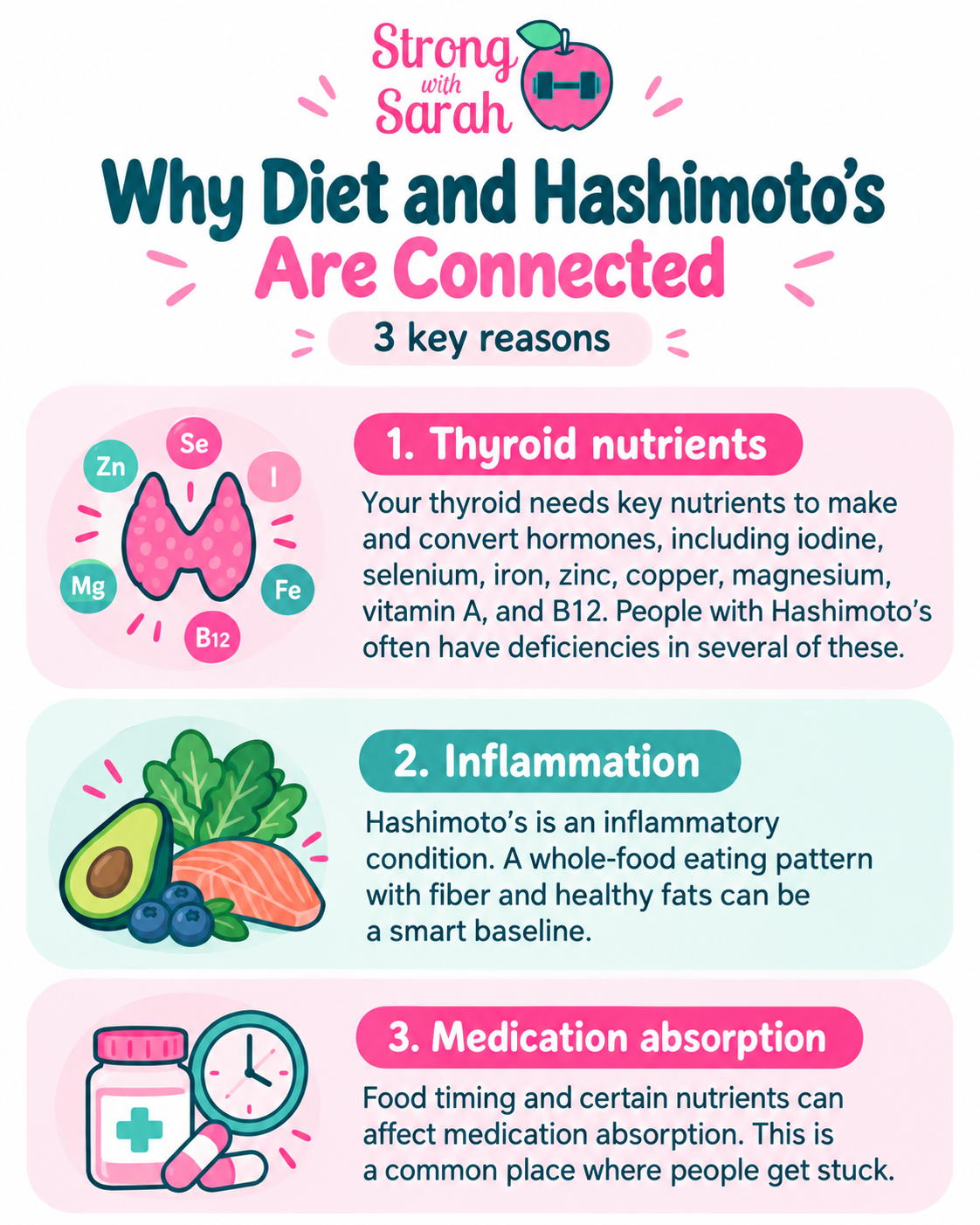
Your diet and Hashimoto's are connected in three main ways:
Nutrients your thyroid needs. Your thyroid relies on micronutrients, such as iodine, selenium, iron, zinc, copper, magnesium, vitamin A, and vitamin B12 to make and convert hormones. Researchers note that people with Hashimoto's often have deficiencies in several of these.
Inflammation. Hashimoto's is an inflammatory condition, so an eating pattern built around whole foods, fiber, and healthy fats is a smart baseline.
Medication absorption. This is the one nobody talks about enough, and it's where I see clients get stuck the most.
The Timing Trick Most People Miss
When you eat certain foods matters just as much as what you eat if you take thyroid medication. A review of levothyroxine and food interactions found that coffee, soy, fiber, and calcium or iron supplements all reduced how much medication people absorbed, and that spacing them out is an effective fix.
I can't tell you how many clients have come to me exhausted, and it turned out they were taking their thyroid pill with their morning latte and a multivitamin. Once they spaced things out, their labs and energy often improved. (Always check your exact routine with your doctor or pharmacist.)
Based on the review, a recommended routine may look like this:
Take your medication first thing with plain water.
Wait 30–60 minutes before coffee or breakfast.
Keep calcium and iron supplements (including multivitamins that contain them) about 4 hours away from your dose.
Be consistent. If you love soy milk or a high-fiber breakfast, you don't have to give it up; just keep it timed away from your pill and keep your intake steady so your doctor can dose you accurately.
Hashimoto's Diet Food List: Anti-Inflammatory Foods to Eat
The best foods for Hashimoto's are the same ones I'd recommend to almost anyone: protein at every meal, lots of colorful produce, healthy fats, and fiber-rich carbs. What's different is paying a little extra attention to the nutrients your thyroid relies on.
When I build a Hashimoto's-friendly plan with a client, I don't hand them a list of 200 approved foods. We start with what they already eat and like, then add from this list one meal at a time.
A Few Notes From the Coaching Side
Protein is my first move with almost every client. Fatigue and cravings are two of the biggest complaints I hear from women with Hashimoto's, and getting 25–30 grams of protein at each meal makes a noticeable difference for a lot of them. If that sounds like a lot, start with breakfast. My 30g protein meal ideas make it easy.
Don't fear cruciferous veggies. Broccoli, kale, and cauliflower get a bad rap online. Cooking them reduces the compounds people worry about, and the amounts in a normal diet aren't a problem for most people. Enjoy your roasted broccoli!
Food first, then test. Before you buy a cart full of supplements, ask your doctor to check your vitamin D, iron (ferritin), and B12. Research reviews have found benefits from vitamin D and selenium supplementation in some people, but more isn't always better, especially with selenium. Supplement based on your actual labs.
10 Foods to Avoid (or Limit) With Hashimoto's
The foods to avoid with Hashimoto's disease are mostly foods to limit or time carefully, not foods you can never eat again. I'm not going to hand you a forbidden list. Restriction backfires, and I've watched too many clients white-knuckle a strict elimination diet for six weeks, then swing hard the other way.
Here's what's actually worth paying attention to:
Iodine supplements and large amounts of seaweed. Iodine is essential, but too much may aggravate autoimmune thyroid disease in some people.
Ultra-processed foods. Packaged snacks, processed meats, and fast food tend to be low in the nutrients your thyroid needs and high in things that don't help inflammation. You don't need to cut them to zero; aim for most of your meals to be built from whole foods.
Added sugar and sugary drinks. Many of my clients with Hashimoto's tell me energy crashes are their biggest struggle. Swapping a daily soda or sweet coffee drink for something lower in sugar is one of the easiest wins I see.
Excess alcohol. Alcohol can mess with sleep and energy, which are often already fragile with Hashimoto's. Keep it moderate and notice how you feel the next day.
Soy, close to your medication. Soy doesn't need to be cut out. It just shouldn't share a time slot with your thyroid pill. Tofu at dinner? Great. Soy latte right after your dose? Consider moving it.
Coffee, right after your dose. Same idea. Coffee itself isn't the problem; drinking it too soon after your medication is. Try waiting at least 30–60 minutes after your dose, then enjoy your cup.
Gluten, if you have celiac disease or a true sensitivity. Celiac disease is more common in people with autoimmune thyroid conditions, so ask your doctor about testing before you cut gluten (going gluten-free first can make the test inaccurate). For people without celiac, a 2025 meta-analysis found the evidence for a gluten-free diet in Hashimoto's isn't strong or convincing. Some people may feel better without it, and that's okay, but it isn't a requirement.
Fried and heavily processed fats. Deep-fried foods and pastries made with processed fats don't do much for inflammation. Replace with olive oil, avocado, nuts, and fish most of the time.
Huge amounts of raw cruciferous veggies. This one's about volume, not broccoli itself. If you're drinking giant raw kale smoothies every single day, mix it up and include cooked veggies too.
Unnecessary supplements, especially biotin, before blood work. High-dose biotin (common in hair, skin, and nail products) can throw off thyroid lab results. Tell your doctor about every supplement you take, and ask whether to pause biotin before your next blood draw.
Notice what's not on this list: carbs, fruit, dairy (unless you're intolerant), chocolate, or the occasional dessert. If a plan for Hashimoto's tells you to cut all of those at once, it's not a plan you can live with.
A Simple Hashimoto's Diet Plan: What a Day Can Look Like
A Hashimoto's diet plan doesn't need to be complicated. Here's the kind of day I'd sketch out with a client, built around medication timing, protein at every meal, and food she actually enjoys.
This isn't a meal plan to follow perfectly. It's a template. Swap in foods you like, and keep the structure: medication first, protein at every meal, plants on most of your plate.
Can You Lose Weight With Hashimoto's?
managed. I won't pretend it's always easy. Many of my clients come to me convinced their thyroid makes weight loss impossible, after years of being told to "just eat less."
What I usually find is that their thyroid is one piece of the puzzle, alongside exhaustion, under-eating protein, stress, poor sleep, and too many crash diets. Once their medication is dialed in with their doctor, the same fundamentals work for them as for anyone: a moderate calorie deficit, enough protein, strength training, and habits they can keep.
Where to Start This Week
You don't need to change everything at once. Pick one of these and do it for the next seven days:
Take your thyroid medication with water and wait 30–60 minutes before coffee.
Add a protein source to breakfast.
Move your calcium or iron supplement to lunch or later.
Ask your doctor about checking vitamin D, ferritin, and celiac antibodies at your next appointment.
That's how lasting change happens: one small habit at a time. And if you'd like support building a plan around your Hashimoto's, your schedule, and the foods you love, that's exactly the kind of work I do with my clients every week.
Hashimoto's Diet FAQ
-
The best diet for Hashimoto's is a balanced, anti-inflammatory eating pattern you can stick to long term, rich in protein, vegetables, fruit, fiber, healthy fats, selenium, zinc, and vitamin D. No single named diet has been proven best, so consistency matters more than following a strict protocol.
-
Only if you have celiac disease or a confirmed sensitivity, or if you notice you feel clearly better without it. Get tested for celiac before cutting gluten, since going gluten-free first can affect test accuracy.
-
Yes. Just wait at least 30–60 minutes after taking your thyroid medication, because coffee can reduce how much of the dose you absorb.
-
Not for most people. Some people with Hashimoto's are lactose intolerant, so if dairy upsets your stomach, try lactose-free options. Keep calcium-rich foods and supplements a few hours away from your medication.
-
The autoimmune protocol (AIP) is a strict elimination diet that some people use short term to identify trigger foods. Research on it is limited and small, and it's hard to sustain. If you're curious, work with a registered dietitian so you can reintroduce foods properly rather than stay restricted indefinitely.
